From Positive to Negative Feedback Loops
underline
In my previous post, I focused on the role of economic and financial institutions in tracking the metabolic and regulatory costs of energy-to-work processes within social subsystems. I discussed how different subsystems rely on distinct energy regimes and emphasized that transitions between these regimes are triggered by the need to govern growth in social complexity and depend on the development of new subsystems with deeper time horizons.
This post addresses the supply chain dimension: their relationship to metabolic and regulatory costs, as well as to risk reduction and other planning mechanisms. I begin by briefly outlining the function of supply chains, the different levels at which they operate, the vulnerabilities that limit their effectiveness, and the systemic risk-reduction strategies surrounding them.
I then use the nation-state framework as an example to illustrate the functions and limitations of supply chains, showing how the economic layer perceives only the aspects of the system it is designed to regulate and metabolize. Finally, I introduce a theoretical framework that explores the potential of using network modalities and consensus mechanisms to reimagine supply chains capable of managing the growth in complexity on a planetary scale.
The proposition of this blog is simple: as long as economies remain embedded in, yet decoupled from their subsystem’s inferred boundaries, growth can be maintained only by manipulating the system’s metabolic and regulatory costs. Therefore, the most important development in the next generation of economic and financial institutions will be to ensure that growth metrics are bound by the metabolic and regulatory costs of the social subsystem, that is, coupled to its negative feedback loop.
end ofbox
Supply Chains
underline
Self-organizing systems persist in changing environments by developing the capacity to anticipate and plan for the metabolic and regulatory costs of their energy-to-work processes, upon which its order relies. Supply chains result from a system’s capacity to anticipate the energy and resources required to maintain its internal order. This blog focuses on three levels of supply chains and their corresponding metabolic and regulatory costs: those that sustain the human body, those that sustain the socioeconomic environment, and those that sustain the political environment.
Supply chains that sustain the human body include the sourcing, processing, and disposal of energy and materials that the body depends on to sustain growth, repair, and adaptation to the environment. They involve the regulatory costs of securing access to food, water, air, energy, and sanitation over time and under changing conditions. Broadly speaking, supply chains at this level are part of, and vital to, maintaining other living systems, from bacteria to forests. While humans perform most of the energy-to-work processes required to maintain their bodies, social systems play a crucial role in regulating access to these resources and managing the disposal of residuals.
Supply chains that sustain the economic environment include the sourcing, processing, and disposal of energy and materials that societies depend on to sustain the growth, repair, and adaptation of their economies. They encompass processes related to the development and maintenance of infrastructure such as housing, transportation, communication, commerce, public spaces, and worship, along with procedures for developing services, industries, and markets that produce and distribute goods. They include the metabolic costs of securing economic infrastructure and the regulatory costs of maintaining and anticipating the system’s socioeconomic needs.
Supply chains that sustain the political environment involve the sourcing, processing, and disposal of energy and materials that societies depend on to sustain growth, repair, and adaptation at the political level. This includes infrastructures that maintain the system’s boundaries, information, knowledge, governance, and bureaucracy, as well as processes such as elections, peer review, journalism, and statistical reporting. They include the metabolic costs of ensuring an informed environment that taps into agents’ potential as agents of change, capable of meeting their societies’ needs, as well as the regulatory costs of anticipating and planning for an unknown future.
While supply chains at each level specialize in different resources and manage distinct aspects of entropy-reducing work, these levels are interconnected and shape the nested subsystems within a given society. The cost-efficiency and resilience of these supply chains determine the overall capacity of a society to perform entropy-reducing work over time and under changing conditions.
end of box
.jpg)
Supply Chains & its Vulnerabilities
underline
Generally speaking, all supply chains both shape and are shaped by the environments in which they are embedded. Each supply chain involves the transformation of raw materials or primary energy sources from the environment into the system, and the disposal of residuals back into the environment. The first source of vulnerability therefore arises from this relationship: environmental factors unmanaged by the system can threaten its supply chains.
Food offers a clear example. Before agriculture and domestication, supply chains at the biological level were determined primarily by environmental conditions. Today, while many societies enjoy a degree of food security through managed production, our systems remain exposed to both natural and human-made disruptions such as wars, droughts, and floods.
Another major vulnerability arises from the processes themselves: since supply chains are based on energy conversion, they must maintain effective waste disposal mechanisms to sustain the system’s function. The system thus depends on the environment’s ability to absorb and regulate its waste cycles to remain effective.
Beyond system–environment vulnerabilities, further fragility emerges from the interdependent nature of supply chains. Supply chains at the political level shape and are shaped by those at the economic level, which in turn influence and are influenced by those at the biological level. This interdependence exposes multiple points of failure within and between supply chains, which underpin the system’s overall entropy-reducing work.
Because supply chains consist of intricate webs of activities that rely on and affect one another, disruptions in one chain can cascade across others that share interfaces. The system’s dependence on supply chains for energy transformation means that inefficiencies and resilience failures directly impact its capacity to regulate and maintain order. Striking a balance between the quality of procedures and the efficiency of metabolic processes is therefore a central challenge and a persistent source of vulnerability.
Boundaries, Risk and Supply Chains
underline
To manage the operation and function of supply chains, social systems rely on two main strategies to mitigate vulnerabilities and improve efficiency.
First, maintaining effective boundaries between the social system and its environment is key. The refrigerator door analogy I mentioned in a previous post is relevant here. Consider two similar refrigerators, both connected to an energy source and filled with the same products: a refrigerator with its door open will consume much more energy and will be less capable of protecting the food from decomposition than one with its door closed.
In this sense, one of the key components of a society’s ability to maintain and improve the efficiency of its supply chains lies in its capacity to sustain boundaries between the system and its environment. Since social feedback loops are abstract boundaries, agents cannot see the door. Instead, they rely on lived experience: monthly expenses, savings rates, terror attacks, and air quality are all signals that help agents assess the efficiency of their society’s boundaries. And while closing a refrigerator door is a straight forward action, maintaining abstract boundaries requires assessing how effectively societal models regulate their boundaries.
The second strategy for maintaining effective supply chains involves sustaining the metabolic and regulatory costs of the supply chains themselves. Social subsystems are therefore dependent on the strength of their risk-taking and risk-sharing strategies to sustain and improve the resilience of their supply chains. The more agents capable of participating in risk-sharing activities, the greater the system’s access to energy. The more agents involved in risk-taking activities, the greater the potential for innovation, cost-effectiveness, and resilience within the system’s supply chains.
Before moving forward with the example of nation-states, their boundaries, supply chains, and risk-sharing methods. I would like to address the issue of growth in relation to open systems.
Supply Chains and Growth in Complexity
underline
Supply chains are not only responsible for providing a system with enough energy to produce work; they must also be capable of effectively managing the system’s growth. And while calls for de-growth strategies are intensifying in current public discourse—particularly around climate change—there are two important factors to bear in mind when discussing the issue of growth.
First, when viewed through the lens of self-organization, growth is inevitable. It follows the arrow of time that governs all open, dynamical, and self-organizing systems. Within their adaptive regions, such systems experience continuous growth in complexity and must find new and better ways to manage that complexity in order to remain adaptive. While this growth intensifies vulnerabilities - both within the system and at the interface between the system and its environment - the alternatives to growth and adaptation are far worse. A self-organizing system may exhibit limited growth when situated in either a stagnant region, where too little happens to be considered growth, or a chaotic region where too much happens, too fast, to stabilize growth.
Stagnant and chaotic states pose immense challenges to a social system’s ability to manage its supply chains at any of the levels mentioned above, making life within such systems increasingly difficult. This leads to the second factor to consider when discussing growth: the link between social organization and growth. Simply put, we live and act in solidarity with others because it is the best, and perhaps only, way to get more out of life. The only reason we tolerate the disadvantages of living in densely populated and interconnected environments is that we stand far better chances of living longer, more prosperous, and more meaningful lives by sharing risks and benefits with others.
One of the clearest social indicators of this aspect of growth is migration. People choose to endure the hardship of making a home away from home primarily because they believe they can live better lives within a social environment capable of securing the supply chains necessary to sustain a growth dynamic. The correlation between social instability and migration challenges the notion that our socially organized life is about preservation and the maintenance of the status quo. Indeed, much of our ability to act together toward a shared purpose depends less on familiarity with each other or with our environment than on access to the resources and capacities that enable us to overcome the perturbations that hinder our efforts to live longer and better lives.
end of box
Nation-States:
Supply Chains & the Management of Growth
underline
While this section focuses on the nation-state, it is important to note that the general trend of nested subsystems is to increase each subsystem’s capacity to manage its lived environment. This is achieved by turning the resources the system needs into well-managed sets of supply chains and by enhancing agents’ collective ability to share risks and distribute benefits among them.
From families to tribes, nations, religions, and, in the modern era, nation-states, each successive subsystem encompasses more agents than the previous one. Each is capable of managing greater complexity and regulating more of its environment than its predecessors. Nation-states, as subsystems, can manage supply chains at biological, social, and political levels, such that the energy-to-work processes of multiple religions, nations, ethnic groups, tribes, and families are sustained within their boundaries—thereby maintaining the social order of the Family of Nations.
To achieve this, nation-states sustain a single negative feedback loop: the monopoly over force. This mechanism maintains the boundaries between a recognized nation-state and its environment. Since only negative feedback loops can provide information about the interface between a system and its environment, this is the only “intelligent” feedback loop in the nation-state system. While more effective than those of smaller subsystems, reliance on a single negative feedback loop means there is no inherent limitation on the regulatory and metabolic costs required to sustain it. Put simply, without the ability to maintain a monopoly over force, this subsystem collapses, leading to the subsequent collapse of all the nested subsystems within its boundaries. Sudan offers a tragic example of a nation-state that failed to sustain its monopoly over force, revealing the fragility of the social subsystems nested within it.
In a sense, the supply chains at both economic and biological levels were designed to accommodate the demands of the political level. The need to absorb the regulatory and metabolic costs of maintaining the monopoly over force places constant pressure on the economic system to continue growing, in order to cover the costs of the nation-state’s negative feedback loop. Most economic supply chains, therefore, are based on positive feedback loops, following patterns of exponential growth and subsequent collapse, mitigated only by the system’s ability to maintain its boundaries.
Why does this matter? For two reasons. First, maintaining a monopoly on force requires continuous investment in warfare innovation. These costs are absorbed by the economic layer, reducing the surplus available for other entropy-reducing functions the system depends on. Second, this design decouples outer from inner boundaries, allowing the state to assert force independently of its capacity to manage and metabolize internal disorder.
In other words, if the only limit on maintaining boundaries is how much risk (through debt and taxation) a nation-state can accrue to sustain its security expenditures, then a nation-state can continue expanding its reach regardless of its ability to manage the metabolic and regulatory costs of its socioeconomic growth.
The most prominent metric that binds a system’s boundaries to its socioeconomic activities is Gross Domestic Product (GDP), defined as the total monetary value of all final goods and services produced within a state’s borders over a given period. GDP growth, measuring how much this total value changes over time, reflects the system’s reliance on a very narrow aspect of economic activity: goods and services that are profitable, in the sense of yielding a margin on investment. In other words, only economic activities that increase monetary returns can support the monopoly over force by providing the funds necessary to sustain and protect the system’s boundaries.
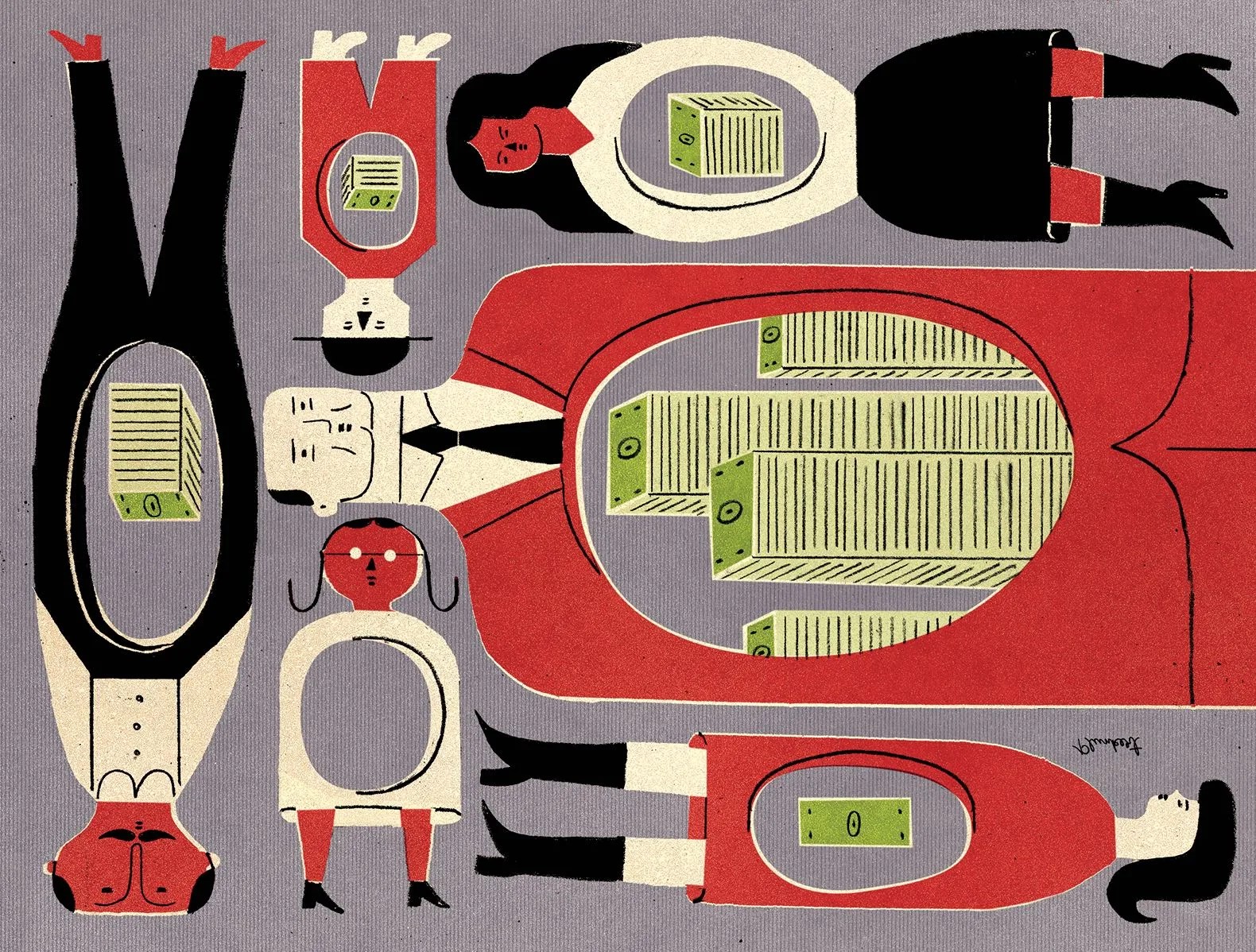
While “making something out of nothing” is a hallmark of human social organization, the framework of generating more money than is invested effectively builds into the system a tendency to externalize most of its metabolic and regulatory costs. Furthermore, this means the system is incapable of accounting for the metabolic or regulatory gains of other forms of entropy-reducing work that occur within its boundaries but outside the free market.
Both these features: the decoupling between boundary expansion and the management of complexity, and the measurement of socioeconomic growth through profitable market activity, directly affect the management of supply chains. This manifests in the externalization of production and waste-management costs; the interpretation of innovation strictly as activities that generate profit; the monopolization of media and information to control political supply chains; and the commodification of the Earth’s entropy-reducing systems.
Furthermore, most of our current supply chains operate under a mechanistic logic that ignores metabolic costs and focuses solely on regulatory ones (insurance, social security, limited liability, etc.). Moreover, margins on investment are achieved primarily by “trusting” the Earth’s self-organizing systems to absorb most production costs, while accounting only for costs that cannot be relegated to other systems, such as searching for, extracting, and manipulating raw materials, or covering mobilization, protection, and efficiency costs (i.e., proving that profit contributes to prosperity).
Thus, security and profit shape the construction of economic models that, on one hand, ignore much of the entropy-reducing work that secures social order, and on the other, distort the metabolic and regulatory costs of most of its economic activities. This is where we are: we have a system that would collapse if we began to factor into its models the real metabolic and regulatory costs of the energy-to-work processes that sustain our societies. At the same time, it ignores most ecosystem services that are provided “for free,” exposing our societies to ongoing exploitation and destruction in the name of a narrow measurement of growth defined by market “products and services.”
end of box
From Nation-States to Consensus Networks
underline
I hope that by now the way forward is conceptually clear, and less tied to existing socioeconomic ideologies that only add tension and divert our attention from the purpose of self-organizing systems: to enable longer, better, and more prosperous lives on Earth.
The first conceptual hint is to keep moving in the direction of more: more agents participating in risk-sharing and risk-taking activities; prediction models capable of regulating more of the environment through their logic; and more parameters factored into our political and socioeconomic metrics and supply chains.
The second conceptual hint points to where the low-hanging fruit lies, i.e., where we can take immediate advantage and achieve the highest returns. While many believe that these opportunities will come in the form of new technologies that will “solve” our problems, the logic articulated thus far suggests otherwise: the highest and most unsustainable prices we pay are rooted in the conceptual frameworks that sustain our social systems. Thinking through these logics, and becoming curious about how other forms of logic in our environment achieve more with less, could lead us to change our worldviews as a precondition for transforming our economies and daily practices. This would, in turn, make room for new technologies to support our efforts, rather than dictate them.
In practical terms, increasing the number of negative feedback loops from which the boundaries of our socioecological systems can be inferred is a promising step. Coupling the expansion of our boundaries with our capacity to manage internal growth in social complexity is another. Next, we can either move from markets to ecologies, or design a free market capable of factoring in the different kinds of entropy-reducing work that living and non-living systems perform daily.
Finally, our societies can become safer with fewer weapons and more information; information that improves our ability to account for the regulatory and metabolic costs of our systems. This, in turn, would allow us to design risk-sharing and risk-taking strategies that support continued growth in complexity and the maintenance of our societal boundaries over time and under changing environmental conditions.
Taken together, these steps can help us develop a new form of economic reasoning. One that contributes to more accurate societal prediction models and to the evolution of effective worldviews, particularly in how we define effective behavior and desirable economic activity. Consensus networks can help shape this transition in several ways. They provide an exceptionally cost-effective means of maintaining boundaries while coupling external control over the environment with greater capacity for internal regulation and adaptive growth. Furthermore, consensus mechanisms function as negative feedback loops in both political and economic supply chains, since they cannot grow without the voluntary support of agents who devote time and resources to the network.
The centrality of agents within these networks is also crucial. It is worth remembering that, in the early stages of nation-states, agents were likewise central to national growth, but over time, they were replaced by far cheaper computers and machines. For now, since we do not yet fully understand the causal structure of Earth’s living systems, human agents can play a vital role in mapping and accounting for metabolic and regulatory costs, as well as in identifying the negative feedback loops that mark the living regions of the Earth’s ecosystems—the very regions that sustain life itself.
end of box

Summary
underline
The negative feedback loop of nation-states taught us to rely on force and to be willing to die for what matters most. Yet the challenges we face today cannot be solved through force, death, or destruction. Rather than learning how to die, we are now encouraged to remember how to defend what we care about most by developing our capacity to be alive. To use attention, curiosity, and creativity to balance our societies along their living edges.
This essay focused on the role of supply chains in sustaining the energy-to-work processes of our social systems and on the role of feedback loops in managing their regulatory and metabolic costs. It highlighted that the only scenario not factored into nation-states’ profit-based and security-oriented systems is the one in which self-sustaining and self-correcting ecosystems lose their ability to balance our economic activities.
If we wish to continue relying on the energy-to-work functions of self-organizing systems, we must understand their boundaries and shape our economies accordingly. Consensus networks point the way forward: they rely on voluntary participation, regenerate trust, and replace domination with mutual regulation. Through them, we may yet remember how to live together: intelligently, attentively, and within the limits that make life not just possible, but incredible.