Through life histories and participatory mapping with 39 members of the Green Belt Movement in Nyeri County, Kenya, a recurring pattern emerged—linking abstract theory to lived experience and revealing the language of a coordination system in locally grounded terms.

The Core Insight

Movements don’t scale by increasing organizational overhead. They scale by stabilizing constraints: shared meanings, practices, and protocols that allow members across distributed networks to act coherently.

Boundaries that
shape coordination:

Physical and informational constraints were described as shaping boundaries around the minimal viable expression of the movement; a small-scale unit that contains the movement in full.

These constraint-inspired boundaries do not limit reach or possibility; rather, they enable members to stay coordinated through shared expectations about how to act together.

Boundaries are interpretive; they centered on what is recognized as sustainable practice, and clear enough that people can identify one another through shared attitudes and actions.

Over time, they become familiar, stable, and easy to follow. This is how the movement maintains coherence even as it grows and changes.

the tree nurseries:

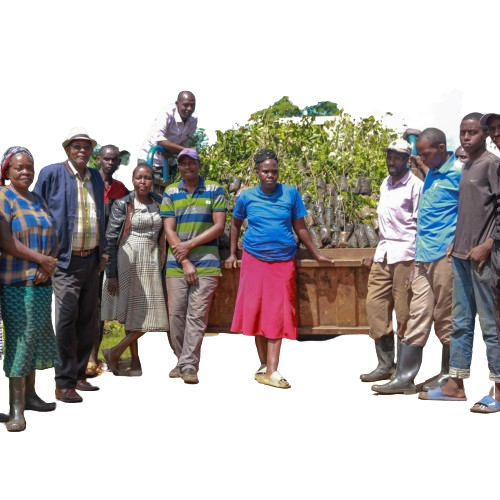
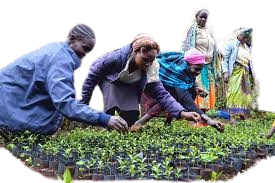
In visited villages, men and women registered nursery groups to grow seedlings. The boundary was simple: within it, members pooled resources, shared tasks, exchanged knowledge, and supported each other. Outside it, other activities like farming, household work and grazing continued as usual.

Because the nursery had a clear purpose and routine, it became a stable place where cooperation could flourish. Over time, this simple boundary helped generate income, strengthen relationships, and build local expertise in tree planting.

Economy that
generates synergy:

A locally rooted and globally coordinated economy emerges through the gradual conversion of types of capital. Participants repeatedly emphasized that the movement first provided knowledge about indigenous trees, and environmental conservation rather than direct financial support

cultural
capital
Black right-pointing arrow icon.
Tangible
Benefits
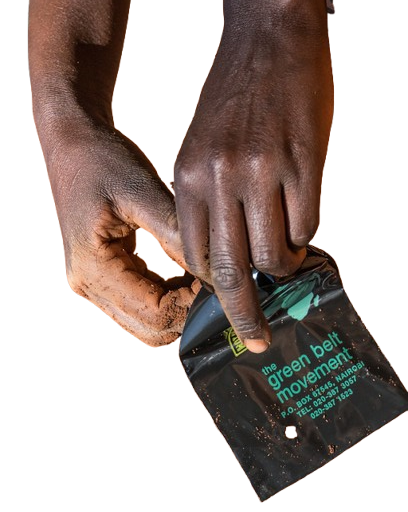
Two dark-skinned hands holding a small black seed packet labeled 'the green belt movement' with contact information.
Young pine tree seedling with green needles in a black plastic nursery bag filled with soil.
Training &
public meetings
Firewood
Figure 1:

GBM engages early adopters through public meetings and immediate benefits—indigenous trees for farm-based firewood.

economic
capital
Black plus sign icon.
social capital
Black plus sign icon.
Symbolic Capital
Black right-pointing arrow icon.
public goods
Two dark-skinned hands holding and letting loose a handful of brown soil.
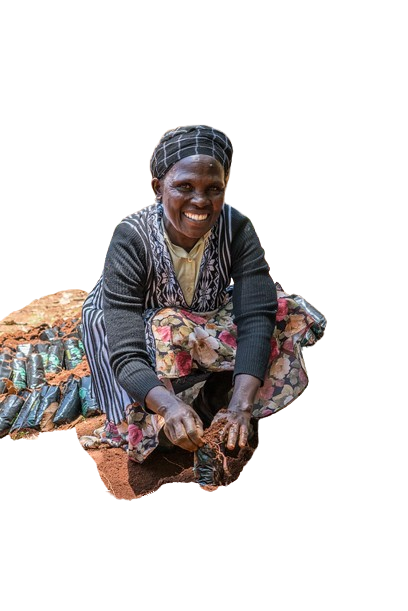
Smiling woman outdoors in headscarf and floral skirt squatting and preparing seedling bags with soil.
Close-up of a person wearing rubber boots squeezing water from a small bulb or seed with water droplets falling.
Group of people standing outdoors around a cart filled with tree seedlings in plastic bags.
Land, tools, bags, water
Neighbors &relatives
A registered nursery
Planting  & monitoring
figure 2:

Receptive members of the community contribute their economic and social capital by registering as a nursery group, enabling regeneration to take root.In many villages, men and women registered nursery groups to grow seedlings.

Building on early gains, participants form nursery groups that pool resources, mobilize networks, and grow into autonomous units of the global movement.

To encourage calculated risk-taking, GBM sustains a stable market for seedlings, compensating nursery members for trees that meet planting standards and green volunteers for monitoring survival rates. This reinforces long-term care and, although modest, creates a new source of income within the local economy.

economic
capital
Black right-pointing arrow icon.
Tangible
Benefits
Illustration of three stacks of gold coins with the number one on top.
Two boys walking, one smiling and holding a stick, the other carrying a backpack.
Compensation
for trees
School fees
Figure 3:

Compensation based on planted trees and survival rates was sufficient to cover school fees in the short term.
economic capital
Black plus sign icon.
symbolic capital
Black right-pointing arrow icon.
natural Capital
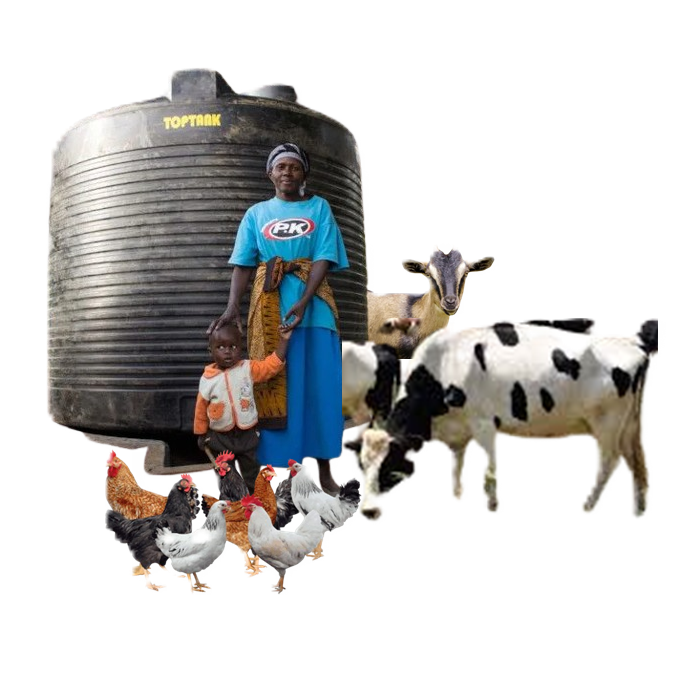
Woman and child standing in front of a large water storage tank with various chickens, a goat, and two cows nearby.
Five people working together to plant or tend seedlings in small pots.
Lush green forest landscape with dense trees and vegetation under a clear sky.
Improved
livelihood
More registered nurseries
ecosystem
services
figure 4:

Over a decade, activities also generated broader economic and symbolic gains for both nursery members and the movement, including expansion of nurseries and gains in natural capital.

Over time, these processes shape self-sustaining modules that renew the synergy between social and ecological systems.

Practices That Shape Collective Identity:

Participation in GBM’s activities shapes both personal and collective identities, linking practical environmental action with a sense of belonging and continuity.

Members narrated an action-based identity through hands-on practices, a civic identity through cooperation and shared responsibility, and a relational identity grounded in ancestral traditions and intergenerational learning.

Together, these layers of identity maintain the coherence of the movement across space and time, sustaining commitment and shared purpose within the broader network.

Governance that Sustains Scale & Coherence:

Governance in GBM combines simple, structured rules with local agency, enabling coordination while allowing participants to adapt, experiment, and improve practices over time.

Three-dimensional red fractal pyramid structure composed of smaller repeating pyramids against a black background.
Tipping Point
Modalities for Scale

Early adopters generate visible benefits that shift local norms. As adoption spreads, practices become self-reinforcing, enabling scale without central control.

Protocols

GBM uses simple protocols for training, planting standards, and monitoring, to create predictable, repeatable action. Together, they create an anticipatory system that links local efforts to global goals.

high agency networks

Participants invest labor and resources under uncertainty but gain autonomy in return. Decision-making power aligns with the level of risk and responsibility assumed.