Value: life
EU-001
The Righteous among the nations

The Righteous among the nations
Item ID 4013684

Value-aligned goals -collective actions aimed at interpreting social values through the principle of equality.
Symmetric tie - A social connection between a bearer of a rejected identity and a citizen, formed with the aim of achieving value-aligned goals.
Consensus network - A network of agents contributing time, skills, and resources to improve the chances of achieving value-aligned goals
My name is Louise Marjanne Beatrix born Samuel. I was born in Holland, July 28th,1938. I am a writer. All of the following took place in Holland. My life had been only brief since I was only two years old at the beginning of the Nazi occupation of Holland.
My parents tried to find me an address where I could go “underground” but it was not easy. Only in 1943, when the last of the Jews had to disappear from Holland, having become Stateless and unprotected by law, a family was found.
My parents tried to find me an address where I could go “underground” but it was not easy. Only in 1943, when the last of the Jews had to disappear from Holland, having become Stateless and unprotected by law, a family was found.
The Righteous among the nations
Item ID 4013684
Value-aligned goals -collective actions aimed at interpreting social values through the principle of equality.
Symmetric tie - A social connection between a bearer of a rejected identity and a citizen, formed with the aim of achieving value-aligned goals.
Consensus network - A network of agents contributing time, skills, and resources to improve the chances of achieving value-aligned goals
The Bemelaar Family came to fetch me from my parents’ home. Mr.Bemelaar and his two young daughters, Willy and Francine and together we travelled by train to Nijmegen which is at the opposite side of Holland, namely in the South.
I lived with this family for some time, I do not know for how long, until something went wrong. I told a little play-mate that my mother was very pretty, having a bright yellow star on her chest… and then I had to leave.The parents of said playmate were Nazi’s.
I lived with this family for some time, I do not know for how long, until something went wrong. I told a little play-mate that my mother was very pretty, having a bright yellow star on her chest… and then I had to leave.The parents of said playmate were Nazi’s.
The Righteous among the nations
Item ID 4013684
Value-aligned goals -collective actions aimed at interpreting social values through the principle of equality.
Symmetric tie - A social connection between a bearer of a rejected identity and a citizen, formed with the aim of achieving value-aligned goals.
Consensus network - A network of agents contributing time, skills, and resources to improve the chances of achieving value-aligned goals
A young man, member of the Dutch resistance took me on a bicycle to a friend of his, who was also a member of the Resistance. His friend was asked to keep the little girl hidden inside a sack of potatoes for the night.
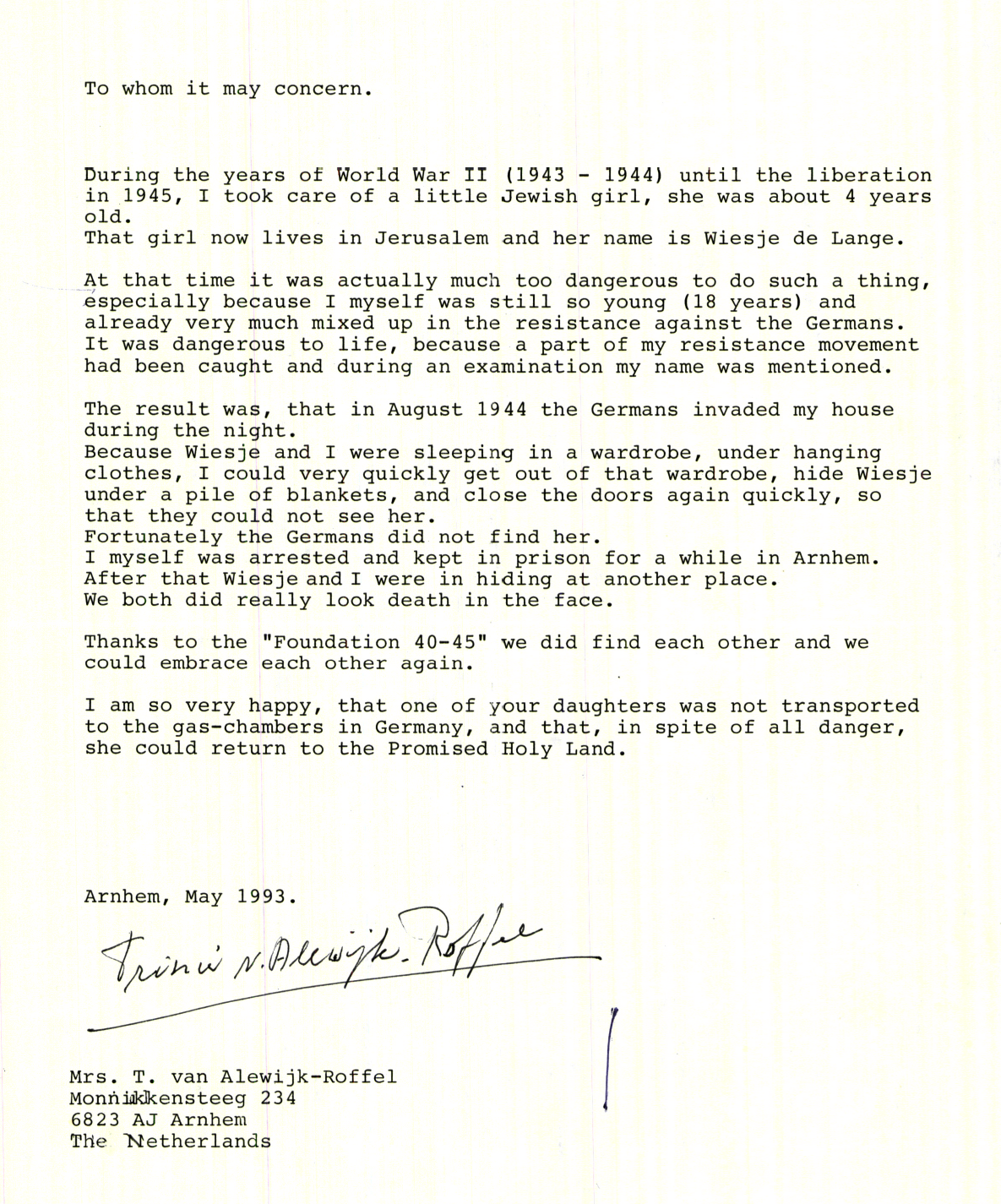
The young girl, Trinie Roffel begged her parents to agree to keep the little “sister” the God had sent her. She was the youngest of maybe 10 children, all of them working in the Resistance. The parents agreed to keep this tiny Jewish daughter until better times would return to Holland and the world.
The young girl, Trinie Roffel begged her parents to agree to keep the little “sister” the God had sent her. She was the youngest of maybe 10 children, all of them working in the Resistance. The parents agreed to keep this tiny Jewish daughter until better times would return to Holland and the world.
The Righteous among the nations
Item ID 4013684
Value-aligned goals -collective actions aimed at interpreting social values through the principle of equality.
Symmetric tie - A social connection between a bearer of a rejected identity and a citizen, formed with the aim of achieving value-aligned goals.
Consensus network - A network of agents contributing time, skills, and resources to improve the chances of achieving value-aligned goals
Sometimes, when Trinie had other “work” to do, and once, when she was imprisoned by the Nazi’s, I had to leave Hengelo but was given to one of the brothers and sisters, all of them married, who kept me for a while, sending me for “vacations” to other brothers, sisters of the large Roffel family who were all like my aunts and uncles. I stayed with Trinie until Holland was liberated by the Canadian forces, in the spring of 1945.

value: Freedom
US-001
The underground railroad
The underground railroad
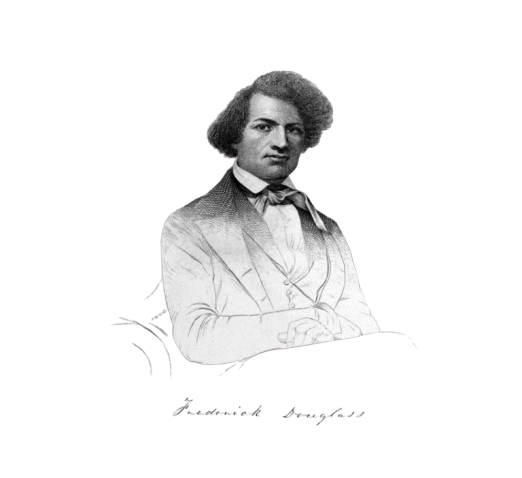
Frederick Douglass
Value-aligned goals -collective actions aimed at interpreting social values through the principle of equality.
Symmetric tie - A social connection between a bearer of a rejected identity and a citizen, formed with the aim of achieving value-aligned goals.
Consensus network - A network of agents contributing time, skills, and resources to improve the chances of achieving value-aligned goals
It was the custom in the state of Maryland to require the free colored people to have what were called freepapers. These instruments they were required to renew very often and by charging a fee for this writing considerable sums from time to time were collected by the State.
This device in some measure defeated itself – since more than one man could be found to answer the same general description... a slave, nearly or sufficiently answering the description set forth in the papers, would borrow or hire them till by means of them he could escape to a free State, and then by mail or otherwise, would return them to the owner.
This device in some measure defeated itself – since more than one man could be found to answer the same general description... a slave, nearly or sufficiently answering the description set forth in the papers, would borrow or hire them till by means of them he could escape to a free State, and then by mail or otherwise, would return them to the owner.
The underground railroad
Frederick Douglass
Value-aligned goals -collective actions aimed at interpreting social values through the principle of equality.
Symmetric tie - A social connection between a bearer of a rejected identity and a citizen, formed with the aim of achieving value-aligned goals.
Consensus network - A network of agents contributing time, skills, and resources to improve the chances of achieving value-aligned goals
The operation was a hazardous one for the lander as well as for the borrower. A failure on the part of the fugitive to send back the papers would imperil his benefactor, and the discovery of the papers in possession of the wrong man would imperil both the fugitive and his friend. It was, therefore, an act of supreme trust on the part of afreeman of color thus to put in jeopardy his own liberty that another might be free. It was, however, not unfrequently bravely done, and was seldom discovered. I was not so fortunate as to resembleany of my free acquaintances sufficiently to answer the description of their papers.
The underground railroad
Frederick Douglass
Value-aligned goals -collective actions aimed at interpreting social values through the principle of equality.
Symmetric tie - A social connection between a bearer of a rejected identity and a citizen, formed with the aim of achieving value-aligned goals.
Consensus network - A network of agents contributing time, skills, and resources to improve the chances of achieving value-aligned goals
I was not so fortunate as to resemble any of my free acquaintances sufficiently to answer the description of their papers. But I hand a friend – a sailor- who owned a sailor’s protection. The instrument had at its head the American eagle, which gave it the appearance at once of anauthorized document.
This protection, when in my hands, did not describe its bearer very accurately... I arranged with Isaac Rolls, a Baltimore Hackman, to bring my baggage to the Philadelphia train just on the moment of starting, and jumped upon the car myself when the train was in motion.
This protection, when in my hands, did not describe its bearer very accurately... I arranged with Isaac Rolls, a Baltimore Hackman, to bring my baggage to the Philadelphia train just on the moment of starting, and jumped upon the car myself when the train was in motion.
The underground railroad
Frederick Douglass
Value-aligned goals -collective actions aimed at interpreting social values through the principle of equality.
Symmetric tie - A social connection between a bearer of a rejected identity and a citizen, formed with the aim of achieving value-aligned goals.
Consensus network - A network of agents contributing time, skills, and resources to improve the chances of achieving value-aligned goals
One element in my favour was the kind feeling which prevailed in Baltimore and other sea-ports at the time, toward “those who go down to the sea in ships...”
I was well on the way to Havre de Grace before the conductor came into the negro car to collect tickets and examine the papers of his black passengers. This was a critical moment in the drama…
He was somewhat harsh in tone and peremptory in manner until he reached me, when, strange enough and to my surprise and relief, his whole manner changed... The merest glance at the paper satisfied him, and he took my fare and went on about his business.
I was well on the way to Havre de Grace before the conductor came into the negro car to collect tickets and examine the papers of his black passengers. This was a critical moment in the drama…
He was somewhat harsh in tone and peremptory in manner until he reached me, when, strange enough and to my surprise and relief, his whole manner changed... The merest glance at the paper satisfied him, and he took my fare and went on about his business.
The underground railroad
Frederick Douglass
Value-aligned goals -collective actions aimed at interpreting social values through the principle of equality.
Symmetric tie - A social connection between a bearer of a rejected identity and a citizen, formed with the aim of achieving value-aligned goals.
Consensus network - A network of agents contributing time, skills, and resources to improve the chances of achieving value-aligned goals
On reaching Philadelphia in the afternoon, I inquired of a colored man how I could get on to New York. He directed me to the William-Steet depot, and thither I went, taking the train that night. My free life began on the third of September, 1838. On the morning of the fourth of that month, after an anxious and most perilous but safe journey, I found myself in the big city of New York, a free man.
I was in the midst of an ocean of my fellow-men, and yet a perfect stranger to everyone. I was without home, without acquaintance, without money, without credit, without work, and without any definite knowledge as to what course to take.
I was in the midst of an ocean of my fellow-men, and yet a perfect stranger to everyone. I was without home, without acquaintance, without money, without credit, without work, and without any definite knowledge as to what course to take.
The underground railroad
Frederick Douglass
Value-aligned goals -collective actions aimed at interpreting social values through the principle of equality.
Symmetric tie - A social connection between a bearer of a rejected identity and a citizen, formed with the aim of achieving value-aligned goals.
Consensus network - A network of agents contributing time, skills, and resources to improve the chances of achieving value-aligned goals
I was indeed free – from slavery, but free from food and shelter as well. I kept my secret to myself as long as I could, but I was compelled at last to seek someone who would befriend me without taking advantage of my destitution to betray me. Such a person I found in a sailor named Stuart... As he approached me I ventured a remark to him which at once enlisted his interest in me.
He took me to his home to spend the night, and in the morning went with me to Mr. David Ruggles, the secretary of the New York vigilance Committee, a co-worker with Isaac T. Hopper, Lewis and Arthus Tappen, Theodore S. Wright, Samuel Cornish, Thomas Downing, Philip A. Bell and other true men of their time.
He took me to his home to spend the night, and in the morning went with me to Mr. David Ruggles, the secretary of the New York vigilance Committee, a co-worker with Isaac T. Hopper, Lewis and Arthus Tappen, Theodore S. Wright, Samuel Cornish, Thomas Downing, Philip A. Bell and other true men of their time.
The underground railroad
Frederick Douglass
Value-aligned goals -collective actions aimed at interpreting social values through the principle of equality.
Symmetric tie - A social connection between a bearer of a rejected identity and a citizen, formed with the aim of achieving value-aligned goals.
Consensus network - A network of agents contributing time, skills, and resources to improve the chances of achieving value-aligned goals
Once in the hands of these brave and wise men, I felt comparatively safe. With Mr. Ruggles, on the corner of Lispenard and church streets, I was hidden several days.
Mr. Ruggles was the first officer on the “Underground Railroad” whom I met after coming North... Learning that my trade was that of a calker, he promptly decided that the best place for me was in New Bedford, Mass. He told me that many ships for whaling voyages were fitted out there, and that I might there find work at my trade and make a good living.
Mr. Ruggles was the first officer on the “Underground Railroad” whom I met after coming North... Learning that my trade was that of a calker, he promptly decided that the best place for me was in New Bedford, Mass. He told me that many ships for whaling voyages were fitted out there, and that I might there find work at my trade and make a good living.
The underground railroad
Frederick Douglass
Value-aligned goals -collective actions aimed at interpreting social values through the principle of equality.
Symmetric tie - A social connection between a bearer of a rejected identity and a citizen, formed with the aim of achieving value-aligned goals.
Consensus network - A network of agents contributing time, skills, and resources to improve the chances of achieving value-aligned goals
We arrived at Newport the next morning, and soon after an old fashioned stage-coach, with “New Bedford” in large yellow letter on its sides, come down to the wharf. I had not money enough to pay our fare, and stood hesitating what to do.
Fortunately for us,there were two Quaker gentlemen who were about to take passage on the stage, friends William C. Taber and Joseph Rickertson – who at once discerned our true situation, and, in a peculiarly quiet way, addressing me, Mr. Taber said: “thee get in.” I never obeyed an order with more alacrity, and we were soon on our way to our new home.
Fortunately for us,there were two Quaker gentlemen who were about to take passage on the stage, friends William C. Taber and Joseph Rickertson – who at once discerned our true situation, and, in a peculiarly quiet way, addressing me, Mr. Taber said: “thee get in.” I never obeyed an order with more alacrity, and we were soon on our way to our new home.
value: freedom
US-002
The underground railroad
The underground railroad
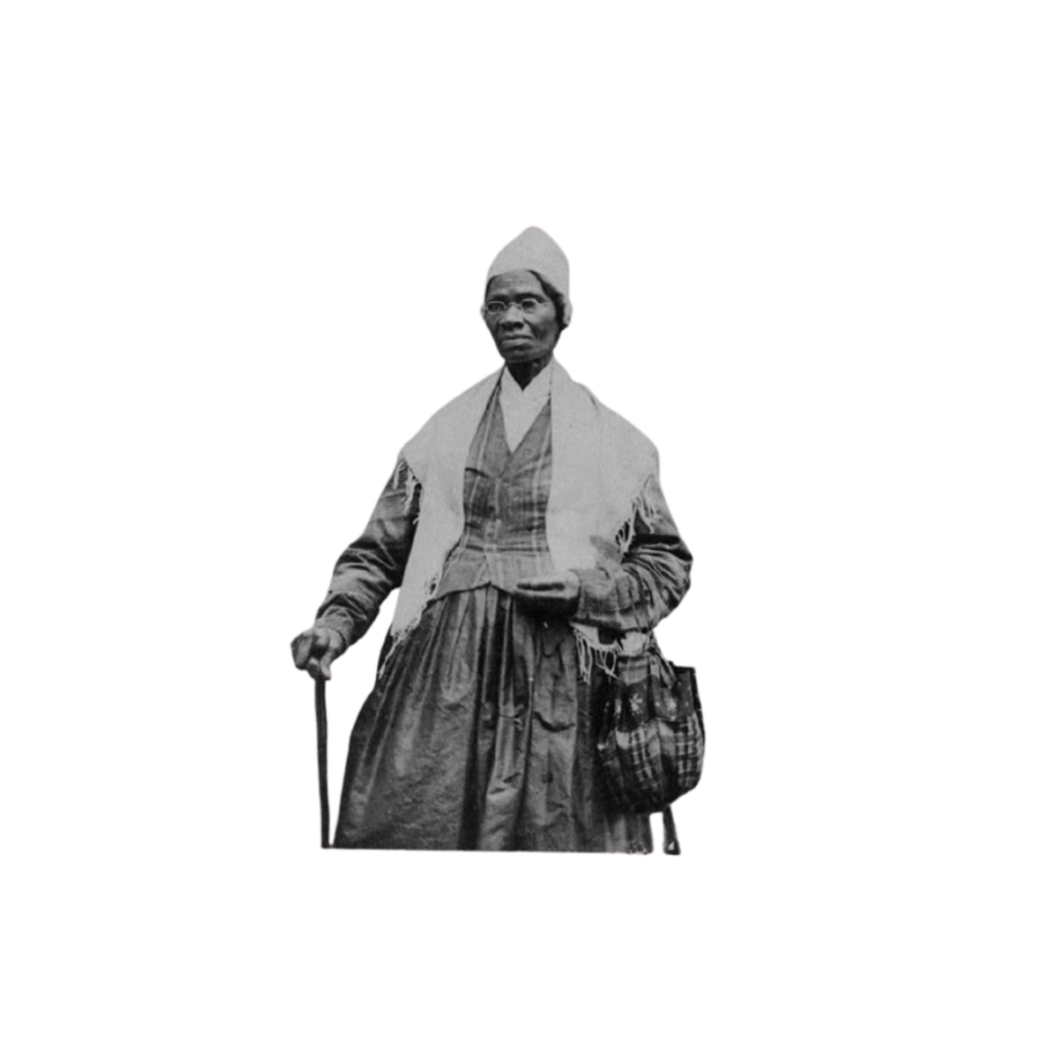
Sojourner Truth
Value-aligned goals -collective actions aimed at interpreting social values through the principle of equality.
Symmetric tie - A social connection between a bearer of a rejected identity and a citizen, formed with the aim of achieving value-aligned goals.
Consensus network - A network of agents contributing time, skills, and resources to improve the chances of achieving value-aligned goals
P. 41
The question in her mind and one not easily solved, now way, ‘how can I getaway?’ so as was her usual custom, she ‘told God she was afraid to go in the night, and in the day everybody would see her.’ At length, the thought came to her that she could leave just before the day dawned and get out of the neighbourhood where she was known before the people were much astir.
... one fine morning a little before day-break, she might have been seen stepping stealthily away from the rear of Master Dumont’s house, her infant on one arm, and her wardrobeon the other.
The question in her mind and one not easily solved, now way, ‘how can I getaway?’ so as was her usual custom, she ‘told God she was afraid to go in the night, and in the day everybody would see her.’ At length, the thought came to her that she could leave just before the day dawned and get out of the neighbourhood where she was known before the people were much astir.
... one fine morning a little before day-break, she might have been seen stepping stealthily away from the rear of Master Dumont’s house, her infant on one arm, and her wardrobeon the other.
The underground railroad
Sojourner Truth
Value-aligned goals -collective actions aimed at interpreting social values through the principle of equality.
Symmetric tie - A social connection between a bearer of a rejected identity and a citizen, formed with the aim of achieving value-aligned goals.
Consensus network - A network of agents contributing time, skills, and resources to improve the chances of achieving value-aligned goals
P. 42
As she gained the summit of a high hill, a considerable distance from her master’s... She stopped to look about her, and ascertain if her pursuers were yet in sight.
No one appeared and, for the first time, the question came up for settlement, 'where and to whom, shall I go?' She sat down, fed her infant, and again turning her thoughts to God, her only help, she prayed him to direct her to some safe asylum.
And soon it occurred to her, that there was a man living somewhere in the direction she had been pursuing, by the name of Levi Rowe, whom she had known, and who,she thought, would be likely to befriend her.
As she gained the summit of a high hill, a considerable distance from her master’s... She stopped to look about her, and ascertain if her pursuers were yet in sight.
No one appeared and, for the first time, the question came up for settlement, 'where and to whom, shall I go?' She sat down, fed her infant, and again turning her thoughts to God, her only help, she prayed him to direct her to some safe asylum.
And soon it occurred to her, that there was a man living somewhere in the direction she had been pursuing, by the name of Levi Rowe, whom she had known, and who,she thought, would be likely to befriend her.
The underground railroad
Sojourner Truth
Value-aligned goals -collective actions aimed at interpreting social values through the principle of equality.
Symmetric tie - A social connection between a bearer of a rejected identity and a citizen, formed with the aim of achieving value-aligned goals.
Consensus network - A network of agents contributing time, skills, and resources to improve the chances of achieving value-aligned goals
She accordingly pursued her way to his house where she found him ready to entertain and assist her, though he was then on his death-bed.
He bade her partake of the hospitalities of his house, said he know of two good places where she might get in, and requested his wife to show her where they were to be found.
As soon as she came in sight of the first house, she recollected having seen it... and instantly exclaimed, ‘That’s the place for me; I shall stop there.’ She went there and found the good people of the house, Mr. and Mrs. Van Wagener, absent, but was kindly received... by their excellent mother, till the return of her children.
He bade her partake of the hospitalities of his house, said he know of two good places where she might get in, and requested his wife to show her where they were to be found.
As soon as she came in sight of the first house, she recollected having seen it... and instantly exclaimed, ‘That’s the place for me; I shall stop there.’ She went there and found the good people of the house, Mr. and Mrs. Van Wagener, absent, but was kindly received... by their excellent mother, till the return of her children.
The underground railroad
Sojourner Truth
Value-aligned goals -collective actions aimed at interpreting social values through the principle of equality.
Symmetric tie - A social connection between a bearer of a rejected identity and a citizen, formed with the aim of achieving value-aligned goals.
Consensus network - A network of agents contributing time, skills, and resources to improve the chances of achieving value-aligned goals
When they arrived... They listened to her story, assuring her they never turned the needy away, and willingly gave her employment.
P. 43
She had not been there long before her old master, Dumont appeared, as she had anticipated... When her master saw her, he said, ‘Well, Bell, so you’ve run away from me.’‘No, I did not run away; I walked away by day-light, and all because you had promised me a year of my time.’
P. 43
She had not been there long before her old master, Dumont appeared, as she had anticipated... When her master saw her, he said, ‘Well, Bell, so you’ve run away from me.’‘No, I did not run away; I walked away by day-light, and all because you had promised me a year of my time.’
The underground railroad
Sojourner Truth
Value-aligned goals -collective actions aimed at interpreting social values through the principle of equality.
Symmetric tie - A social connection between a bearer of a rejected identity and a citizen, formed with the aim of achieving value-aligned goals.
Consensus network - A network of agents contributing time, skills, and resources to improve the chances of achieving value-aligned goals
Mr. Isaac S. Van Wagener then interposed, saying, he had never been in the practice of buying and selling slaves; he did not believe in slavery, but rather than have Isabella taken back by force, he would buy her services for the balance of the year – for which her master charged twenty dollars, and five in addition for the child. The sum was paid, and her master Dumont departed; but not till he had heard Mr. Van Wagener tell her not to call him master, adding, ‘there is but one mater; and he who is your master in my master.’ Isabella inquired what she should call him? He answered, ‘call me Isaac Van Wagener, and my wife is Maria Van Wagener.’
value: life
EU-002
The Righteous among the nations
The Righteous among the nations
Item ID 4043179
Value-aligned goals -collective actions aimed at interpreting social values through the principle of equality.
Symmetric tie - A social connection between a bearer of a rejected identity and a citizen, formed with the aim of achieving value-aligned goals.
Consensus network - A network of agents contributing time, skills, and resources to improve the chances of achieving value-aligned goals
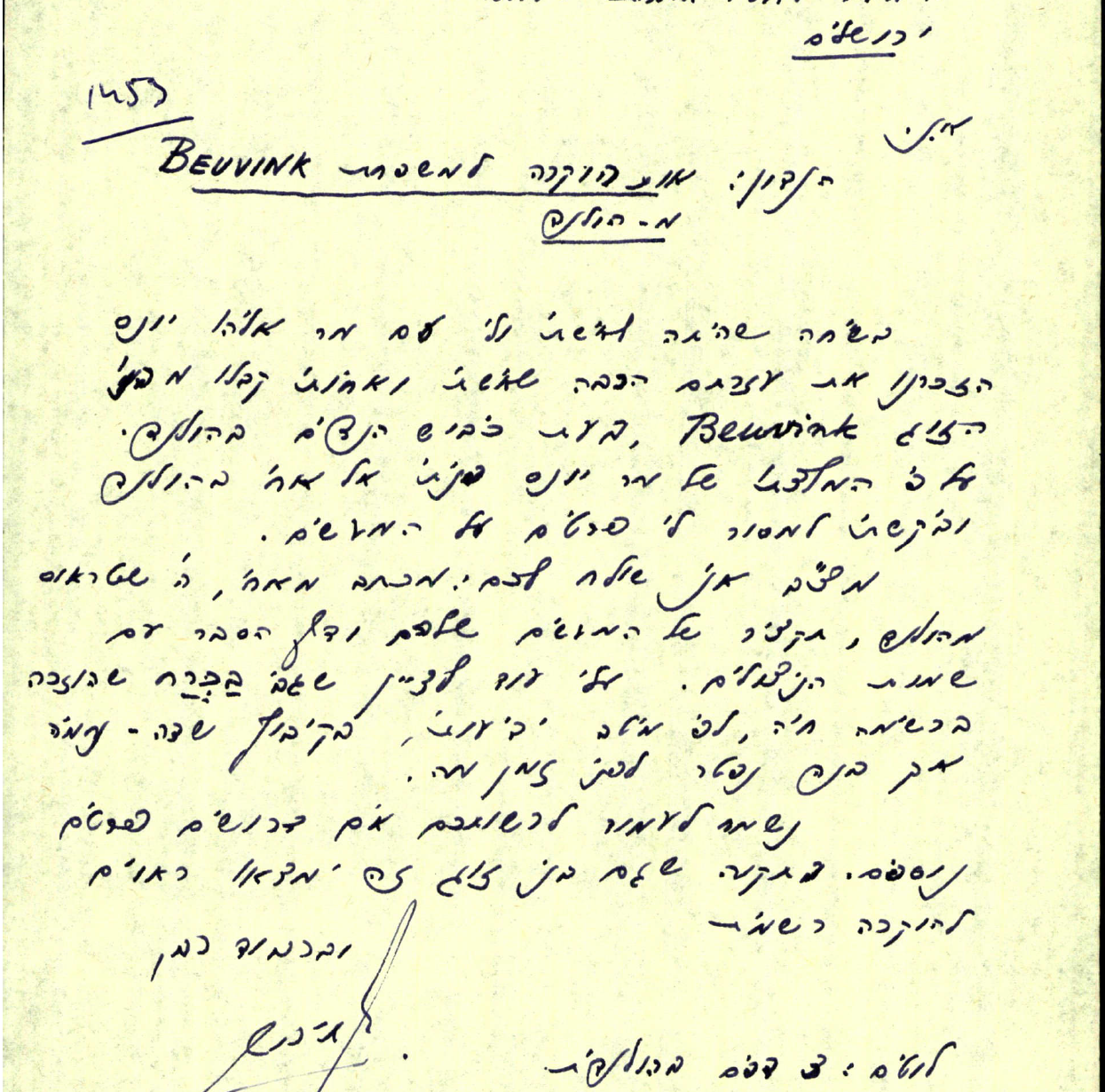
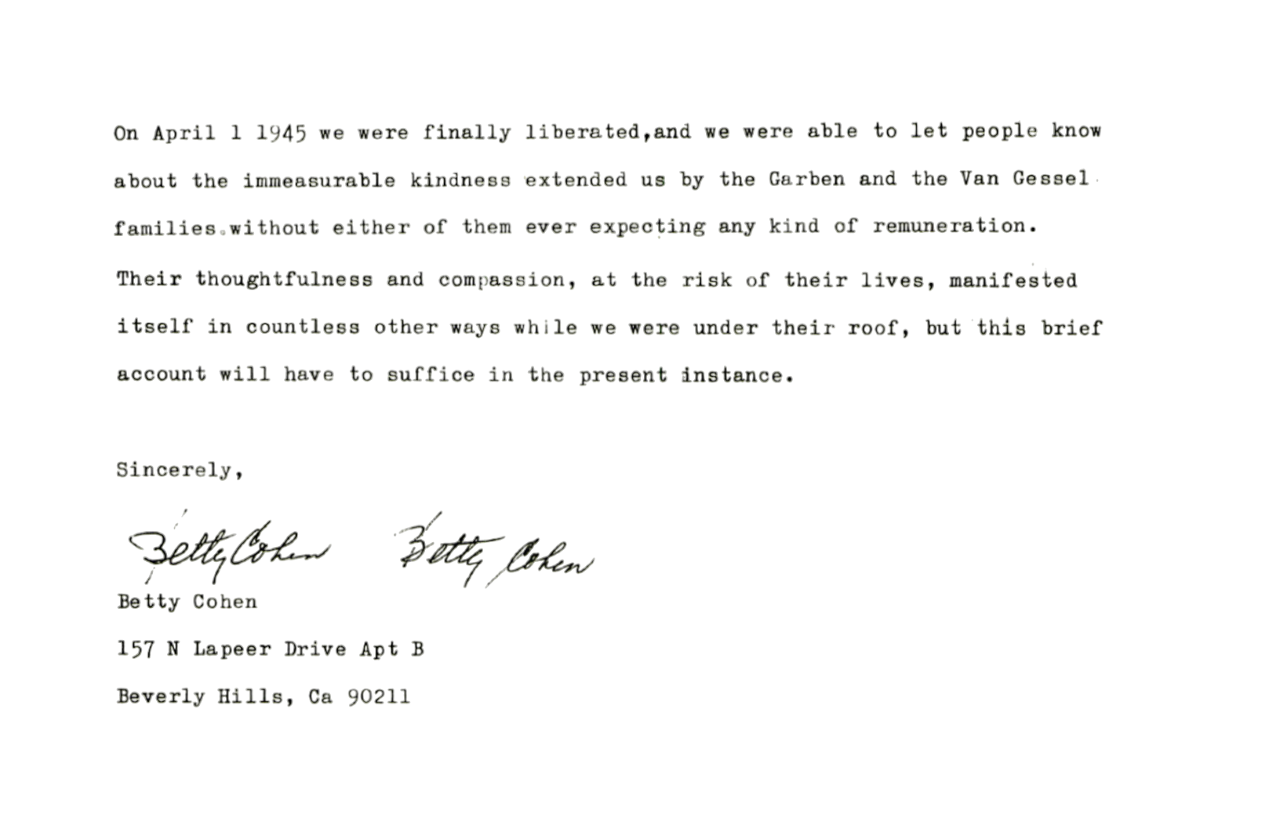
My name is Betty Cohen. I was born Sara Betty Straus on 13-04-1920 in the town of s’Heerenberg Holland. My sister Diny and I had been hiding for approximately one year at the house of Mrs. Van Gessel in Dieren Holland.
The Van Gessel family took us in after we had been forced to flee our home ins’Heerenberg. It became imperative for us to leave the Van Gessel family due to arrests of several of our underground friends.
The Van Gessel family took us in after we had been forced to flee our home ins’Heerenberg. It became imperative for us to leave the Van Gessel family due to arrests of several of our underground friends.
The Righteous among the nations
Item ID 4043179
Value-aligned goals -collective actions aimed at interpreting social values through the principle of equality.
Symmetric tie - A social connection between a bearer of a rejected identity and a citizen, formed with the aim of achieving value-aligned goals.
Consensus network - A network of agents contributing time, skills, and resources to improve the chances of achieving value-aligned goals
The oldest daughter of Mrs. Van Gessel, Ali, and her fiancée, Tieme Beuving, accompanied us to our next hide-out. It was a dangerous 25 Kilometer bicycle trip to a little hamlet named Azewijn. One of the dangers facing us was the crossing of the river Ijsel, heavily guarded by German soldiers.
We crossed the river safely (a miracle!). We arrived at a small farmhouse occupied by Mr. and Mrs. Garben, a couplein their eighties, their daughter Agnes and their son Johannes. We were united with our younger brother Harry who had been staying with the Garben family for a few weeks prior to our arrival.
We crossed the river safely (a miracle!). We arrived at a small farmhouse occupied by Mr. and Mrs. Garben, a couplein their eighties, their daughter Agnes and their son Johannes. We were united with our younger brother Harry who had been staying with the Garben family for a few weeks prior to our arrival.
The Righteous among the nations
Item ID 4043179
Value-aligned goals -collective actions aimed at interpreting social values through the principle of equality.
Symmetric tie - A social connection between a bearer of a rejected identity and a citizen, formed with the aim of achieving value-aligned goals.
Consensus network - A network of agents contributing time, skills, and resources to improve the chances of achieving value-aligned goals
Early the following morning we left the Garben farmhouse and walked about 100 yards through an orchard to an old farm. This old house… was to be our home for the next 15 months. The house was inappropriately named “the villa.” A villait was not, but it became something much more important: a safe hiding place…
We kept busy with anything we could think of. We studied English, made up puzzles, knitted sweaters and such for the Garben family, in short, we helped with anything we could. [When] My brother and I were seriously ill during that time Agnes was able to get our former family doctor to treat us.
We kept busy with anything we could think of. We studied English, made up puzzles, knitted sweaters and such for the Garben family, in short, we helped with anything we could. [When] My brother and I were seriously ill during that time Agnes was able to get our former family doctor to treat us.
The Righteous among the nations
Item ID 4043179
Value-aligned goals -collective actions aimed at interpreting social values through the principle of equality.
Symmetric tie - A social connection between a bearer of a rejected identity and a citizen, formed with the aim of achieving value-aligned goals.
Consensus network - A network of agents contributing time, skills, and resources to improve the chances of achieving value-aligned goals
Another important event during this period was a four-day stay of two American air-force officers with us. Their plane had been riddled with bullets by the Germans but the fliers managed to set it down just inside of the Dutch border.
The “Underground” snatched the fliers away before the onrushing Germansoldiers. The Garben’s were asked to hide the Americans for a few days. We were thrilled to meet the Americans. Our study of English finally began to pay off although we were barely able to undertand them.
The “Underground” snatched the fliers away before the onrushing Germansoldiers. The Garben’s were asked to hide the Americans for a few days. We were thrilled to meet the Americans. Our study of English finally began to pay off although we were barely able to undertand them.
The Righteous among the nations
Item ID 4043179
vlue: life
EU-003
The Righteous among the nations
The Righteous among the nations
Item ID 9371191
Value-aligned goals -collective actions aimed at interpreting social values through the principle of equality.
Symmetric tie - A social connection between a bearer of a rejected identity and a citizen, formed with the aim of achieving value-aligned goals.
Consensus network - A network of agents contributing time, skills, and resources to improve the chances of achieving value-aligned goals
My family and I went into hiding in early summer, 1942. I went together with my twelve years old brother to friends in the university town of Leiden. Since the house was small and the family had three very young children, it became clear very soon that we could not remain there.
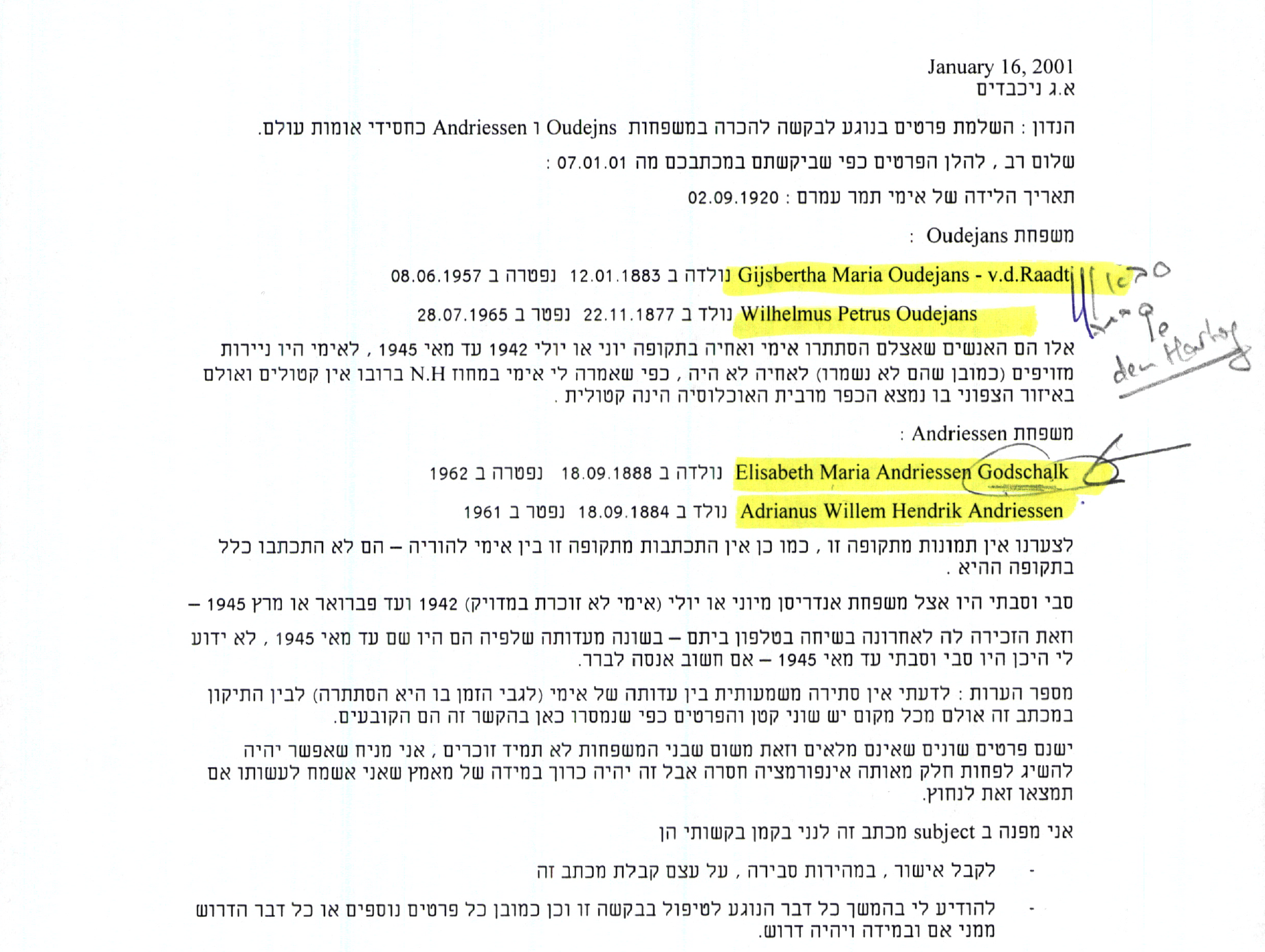
I turned to a fried, a Roman Catholic priest who was a study colleague of mine and who I know was involved in underground activities, and asked him for help. One or two days later he came with a friend, another R.C. priest, Father J. Oudejans O.F.M living in the northern part of the country in a small village called Spierdijk.
I turned to a fried, a Roman Catholic priest who was a study colleague of mine and who I know was involved in underground activities, and asked him for help. One or two days later he came with a friend, another R.C. priest, Father J. Oudejans O.F.M living in the northern part of the country in a small village called Spierdijk.
The Righteous among the nations
Item ID 9371191
Value-aligned goals -collective actions aimed at interpreting social values through the principle of equality.
Symmetric tie - A social connection between a bearer of a rejected identity and a citizen, formed with the aim of achieving value-aligned goals.
Consensus network - A network of agents contributing time, skills, and resources to improve the chances of achieving value-aligned goals
That same night Father Oudejans took [us] on very risky journey by train. At that time there still was some railway traffic for civilians, but it was dangerous. We arrived safely and the elderly Mr. and Mrs. Oudejans received us like long awaited and most welcome guests…
My brother and I had a small room for ourselves where we slept and where I gave my brother his lessons for school. A rather primitive hiding place was installed in the cellar; there we went if there was any sign of Germans in the area... there must have been people who know of our existence, I don’t know for sure, but the area was “safe."
My brother and I had a small room for ourselves where we slept and where I gave my brother his lessons for school. A rather primitive hiding place was installed in the cellar; there we went if there was any sign of Germans in the area... there must have been people who know of our existence, I don’t know for sure, but the area was “safe."
The Righteous among the nations
Item ID 9371191
Value-aligned goals -collective actions aimed at interpreting social values through the principle of equality.
Symmetric tie - A social connection between a bearer of a rejected identity and a citizen, formed with the aim of achieving value-aligned goals.
Consensus network - A network of agents contributing time, skills, and resources to improve the chances of achieving value-aligned goals
[during] the last months of the war – the period of the so-called “hunger-winter,” many people from the cities roamed the country side in search of food, so we had to be extra careful. Secondly, the Germans, who know they were going to be defeated in the war, used these last months to make big last hunts for Jews and made extensive house searching everywhere.
The hiding place we had in the house, was not safe enough... my brother and I moved to the big attic of the farm-house where the hay was stored. There we stayed till the end. During all that time, two times a day, Mr. Oudejans brought us our meals and changed the pail we used for our needs.
The hiding place we had in the house, was not safe enough... my brother and I moved to the big attic of the farm-house where the hay was stored. There we stayed till the end. During all that time, two times a day, Mr. Oudejans brought us our meals and changed the pail we used for our needs.
The Righteous among the nations
Item ID 9371191

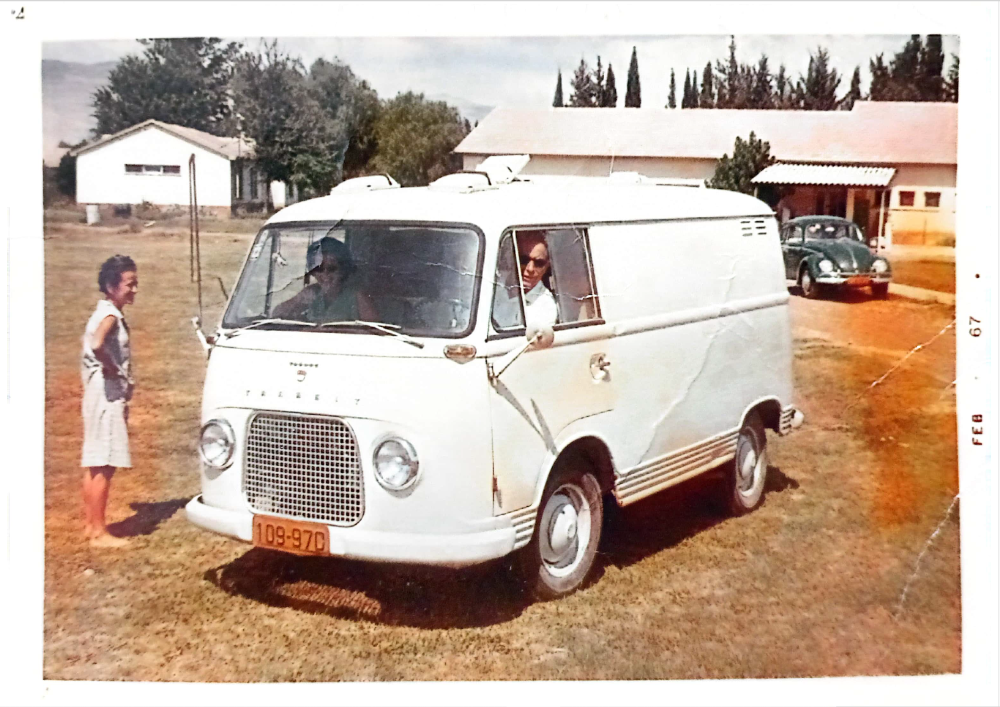
Standing on the left beside my grandparents’ car is the narrator, whom I came to know as tante Tini, always barefoot and smiling.
She taught me that humans are never a problem to be solved. I’m grateful for her rescue.
She taught me that humans are never a problem to be solved. I’m grateful for her rescue.
Value freedom
US-003
the underground railroad
the underground railroad
Henry Bibb
Value-aligned goals -collective actions aimed at interpreting social values through the principle of equality.
Symmetric tie - A social connection between a bearer of a rejected identity and a citizen, formed with the aim of achieving value-aligned goals.
Consensus network - A network of agents contributing time, skills, and resources to improve the chances of achieving value-aligned goals
P.13
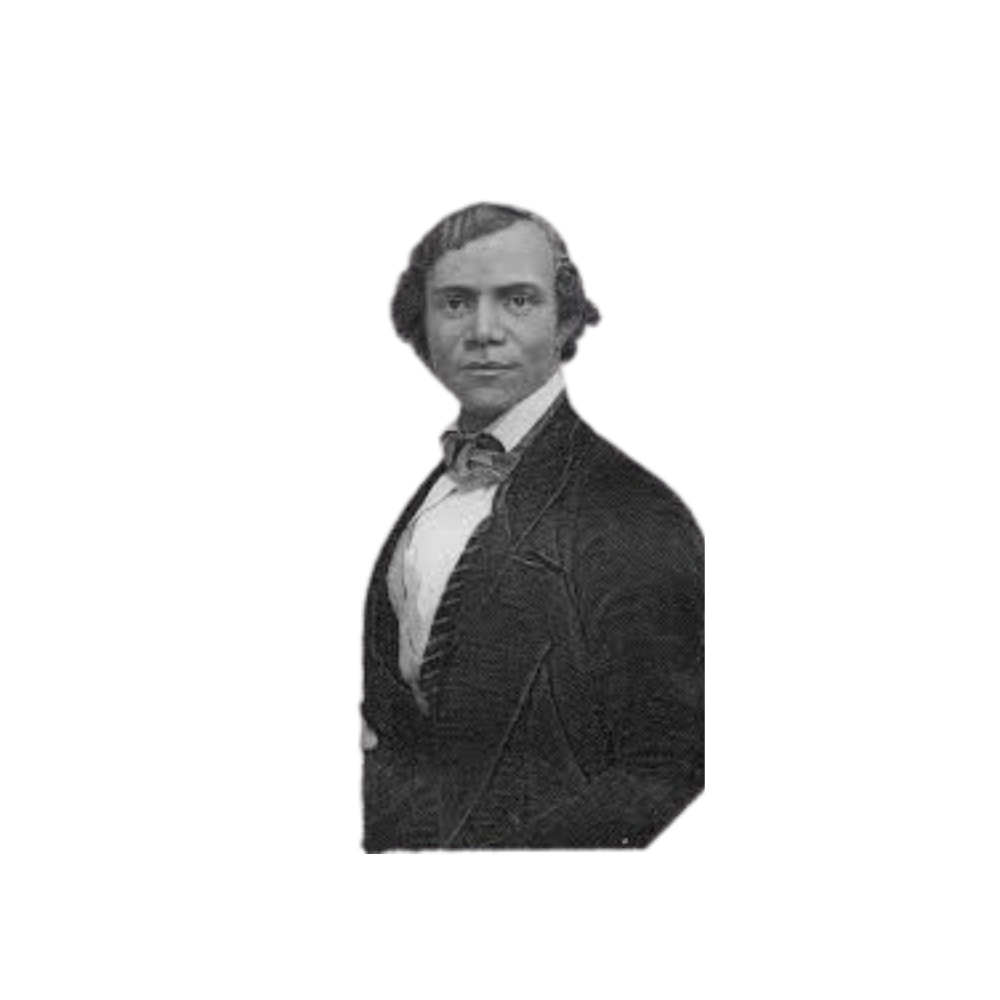
I was born May 1815, of a slave mother, in Shelby County, Kentucky, and was claimed as the property of David White Esq. I was brought up in the Counties of Shelby,Henry, Oldham, and Trimble. Or, more correctly speaking, in the above counties, I may safely say, I was flogged up; for where I should have received moral, mental, and religious instruction, I received stripes without number, the object of which was to degrade and keep me in subordination... I have been dragged down to the lowest depths of human degradation and wretchedness, by Slaveholders.
I was born May 1815, of a slave mother, in Shelby County, Kentucky, and was claimed as the property of David White Esq. I was brought up in the Counties of Shelby,Henry, Oldham, and Trimble. Or, more correctly speaking, in the above counties, I may safely say, I was flogged up; for where I should have received moral, mental, and religious instruction, I received stripes without number, the object of which was to degrade and keep me in subordination... I have been dragged down to the lowest depths of human degradation and wretchedness, by Slaveholders.
the underground railroad
Henry Bibb
Value-aligned goals -collective actions aimed at interpreting social values through the principle of equality.
Symmetric tie - A social connection between a bearer of a rejected identity and a citizen, formed with the aim of achieving value-aligned goals.
Consensus network - A network of agents contributing time, skills, and resources to improve the chances of achieving value-aligned goals
P. 47
By the permission of my keeper, I started out to work for myself on Christmas. I went to the Ohio River, which was but a short distance from Bedford. My excuse for wanting to go there was to get work. High wages were offered for hands to work in a slaughter-house. But in place of my going to work there, according to promise, when I arrived at the river I managed to find a conveyance to cross over into a free state. I was landed in the village of Madison, Indiana, where steamboats were landing every day and night, passing up and down the river, which afforded me a good opportunity of getting a boat passage to Cincinnati.
By the permission of my keeper, I started out to work for myself on Christmas. I went to the Ohio River, which was but a short distance from Bedford. My excuse for wanting to go there was to get work. High wages were offered for hands to work in a slaughter-house. But in place of my going to work there, according to promise, when I arrived at the river I managed to find a conveyance to cross over into a free state. I was landed in the village of Madison, Indiana, where steamboats were landing every day and night, passing up and down the river, which afforded me a good opportunity of getting a boat passage to Cincinnati.
the underground railroad
Henry Bibb
... no sooner was the curtain of night dropped over the village, than I secreted myself where no one could see me, and changed my suit ready for the passage.
P.50
The boat landed about 9 o'clock in the morning in Cincinnati, and I waited until after most of the passengers had gone off of the boat; I then walked as gracefully up street as if I was not running away, until I had got pretty well up Broadway. My object was to go to Canada, but having no knowledge of the road, it was necessary for me to make some inquiry before I left the city.
P.50
The boat landed about 9 o'clock in the morning in Cincinnati, and I waited until after most of the passengers had gone off of the boat; I then walked as gracefully up street as if I was not running away, until I had got pretty well up Broadway. My object was to go to Canada, but having no knowledge of the road, it was necessary for me to make some inquiry before I left the city.
Value-aligned goals -collective actions aimed at interpreting social values through the principle of equality.
Symmetric tie - A social connection between a bearer of a rejected identity and a citizen, formed with the aim of achieving value-aligned goals.
Consensus network - A network of agents contributing time, skills, and resources to improve the chances of achieving value-aligned goals
the underground railroad
Henry Bibb
Value-aligned goals -collective actions aimed at interpreting social values through the principle of equality.
Symmetric tie - A social connection between a bearer of a rejected identity and a citizen, formed with the aim of achieving value-aligned goals.
Consensus network - A network of agents contributing time, skills, and resources to improve the chances of achieving value-aligned goals
I was afraid to ask a white person, and I could see no colored person to ask. But fortunately for me I found a company of little boys at play in the street, and through these little boys, by asking them indirect questions, I found the residence of a colored man.
Mr. D. invited me in, and I found him to be a true friend. He asked me if I was a slave from Kentucky... Not knowing yet whether he was truly in favor of slaves running away, I told him that I had just come over to spend my Christmas holydays... His reply was, "my son, I would never go back if I was in your place; you have a right to your liberty."
Mr. D. invited me in, and I found him to be a true friend. He asked me if I was a slave from Kentucky... Not knowing yet whether he was truly in favor of slaves running away, I told him that I had just come over to spend my Christmas holydays... His reply was, "my son, I would never go back if I was in your place; you have a right to your liberty."
the underground railroad
Henry Bibb
Value-aligned goals -collective actions aimed at interpreting social values through the principle of equality.
Symmetric tie - A social connection between a bearer of a rejected identity and a citizen, formed with the aim of achieving value-aligned goals.
Consensus network - A network of agents contributing time, skills, and resources to improve the chances of achieving value-aligned goals
I then asked him how I should get my freedom. He referred me to Canada, over which waved freedom's flag, defended by the British Government, upon whose soil there cannot be the foot print of a slave.
.He then commenced telling me of the facilities for my escape to Canada; of the Abolitionists; of the Abolition Societies, and of their fidelity to the cause of suffering humanity.
He conducted me to the house of one of these warm-hearted friends of God and the slave. I found him willing to aid a poor fugitive on his way to Canada, even to the dividing of the last cent, or morsel of bread if necessary.
.He then commenced telling me of the facilities for my escape to Canada; of the Abolitionists; of the Abolition Societies, and of their fidelity to the cause of suffering humanity.
He conducted me to the house of one of these warm-hearted friends of God and the slave. I found him willing to aid a poor fugitive on his way to Canada, even to the dividing of the last cent, or morsel of bread if necessary.
the underground railroad
Henry Bibb
Value-aligned goals -collective actions aimed at interpreting social values through the principle of equality.
Symmetric tie - A social connection between a bearer of a rejected identity and a citizen, formed with the aim of achieving value-aligned goals.
Consensus network - A network of agents contributing time, skills, and resources to improve the chances of achieving value-aligned goals
These kind friends gave me something to eat, and started me on my way to Canada, with a recommendation to a friend on my way. This was the commencement of what was called the underground rail road to Canada.
P. 55
I arrived the next morning in the village of Perrysburgh, where I found quite a settlement of colored people, many of whom were fugitive slaves. I was a stranger, and they took me in and persuaded me to spend the winter in Perrysburgh, where I could get employment and go to Canada the next spring, in a steamboat which run from Perrysburgh...
P. 55
I arrived the next morning in the village of Perrysburgh, where I found quite a settlement of colored people, many of whom were fugitive slaves. I was a stranger, and they took me in and persuaded me to spend the winter in Perrysburgh, where I could get employment and go to Canada the next spring, in a steamboat which run from Perrysburgh...
the underground railroad
Henry Bibb
Value-aligned goals -collective actions aimed at interpreting social values through the principle of equality.
Symmetric tie - A social connection between a bearer of a rejected identity and a citizen, formed with the aim of achieving value-aligned goals.
Consensus network - A network of agents contributing time, skills, and resources to improve the chances of achieving value-aligned goals
P. 55
My intention was to go back to Kentucky after my wife. When I got ready to start, which was about the first of May, my friends all persuaded me not to go, but to get some other person to go, for fear I might be caught and sold off from my family into slavery forever. But I could not refrain from going back myself, believing that I could accomplish it better than a stranger.
[Henry Bibb was caught by slave hunters and sold several times. Despite his sincere efforts to rescue his family, he ended up losing touch with their where abouts]
My intention was to go back to Kentucky after my wife. When I got ready to start, which was about the first of May, my friends all persuaded me not to go, but to get some other person to go, for fear I might be caught and sold off from my family into slavery forever. But I could not refrain from going back myself, believing that I could accomplish it better than a stranger.
[Henry Bibb was caught by slave hunters and sold several times. Despite his sincere efforts to rescue his family, he ended up losing touch with their where abouts]
the underground railroad
Henry Bibb
Value-aligned goals -collective actions aimed at interpreting social values through the principle of equality.
Symmetric tie - A social connection between a bearer of a rejected identity and a citizen, formed with the aim of achieving value-aligned goals.
Consensus network - A network of agents contributing time, skills, and resources to improve the chances of achieving value-aligned goals
P. 170
When the steamboat arrived at Portsmouth, Ohio, I took off my trunk with the intention of going to Canada. But my funds were almost exhausted, so I had to stop and go to work to get money to travel on.
... I then made up my mind to leave Portsmouth; its location being right on the border of a slave State. A short time after this a gentleman put up there over night named Smith, from Perrysburgh, with whom I was acquainted in the North. He was on his way to Kentucky to buy up a drove of fine horses, and he wanted me to go and help him to drive his horses out to Perrysburgh, and said he would pay all my expenses if I would go.
When the steamboat arrived at Portsmouth, Ohio, I took off my trunk with the intention of going to Canada. But my funds were almost exhausted, so I had to stop and go to work to get money to travel on.
... I then made up my mind to leave Portsmouth; its location being right on the border of a slave State. A short time after this a gentleman put up there over night named Smith, from Perrysburgh, with whom I was acquainted in the North. He was on his way to Kentucky to buy up a drove of fine horses, and he wanted me to go and help him to drive his horses out to Perrysburgh, and said he would pay all my expenses if I would go.
the underground railroad
Henry Bibb
Value-aligned goals -collective actions aimed at interpreting social values through the principle of equality.
Symmetric tie - A social connection between a bearer of a rejected identity and a citizen, formed with the aim of achieving value-aligned goals.
Consensus network - A network of agents contributing time, skills, and resources to improve the chances of achieving value-aligned goals
P. 174
When I arrived [back] at Perrysburgh, I went to work for Mr. Smith for several months. This family I found to be one of the most kind-hearted, and unprejudiced that I ever lived with. Mr. and Mrs. Smith lived up to their profession.
My occupation varied according to circumstances, as I was not settled in mind about the condition of my bereaved family for several years, and could not settle myself down at any permanent business.
When I arrived [back] at Perrysburgh, I went to work for Mr. Smith for several months. This family I found to be one of the most kind-hearted, and unprejudiced that I ever lived with. Mr. and Mrs. Smith lived up to their profession.
My occupation varied according to circumstances, as I was not settled in mind about the condition of my bereaved family for several years, and could not settle myself down at any permanent business.
value: life
EU-004
The Righteous among the nations
The Righteous among the nations
ID item 4059850
Value-aligned goals -collective actions aimed at interpreting social values through the principle of equality.
Symmetric tie - A social connection between a bearer of a rejected identity and a citizen, formed with the aim of achieving value-aligned goals.
Consensus network - A network of agents contributing time, skills, and resources to improve the chances of achieving value-aligned goals
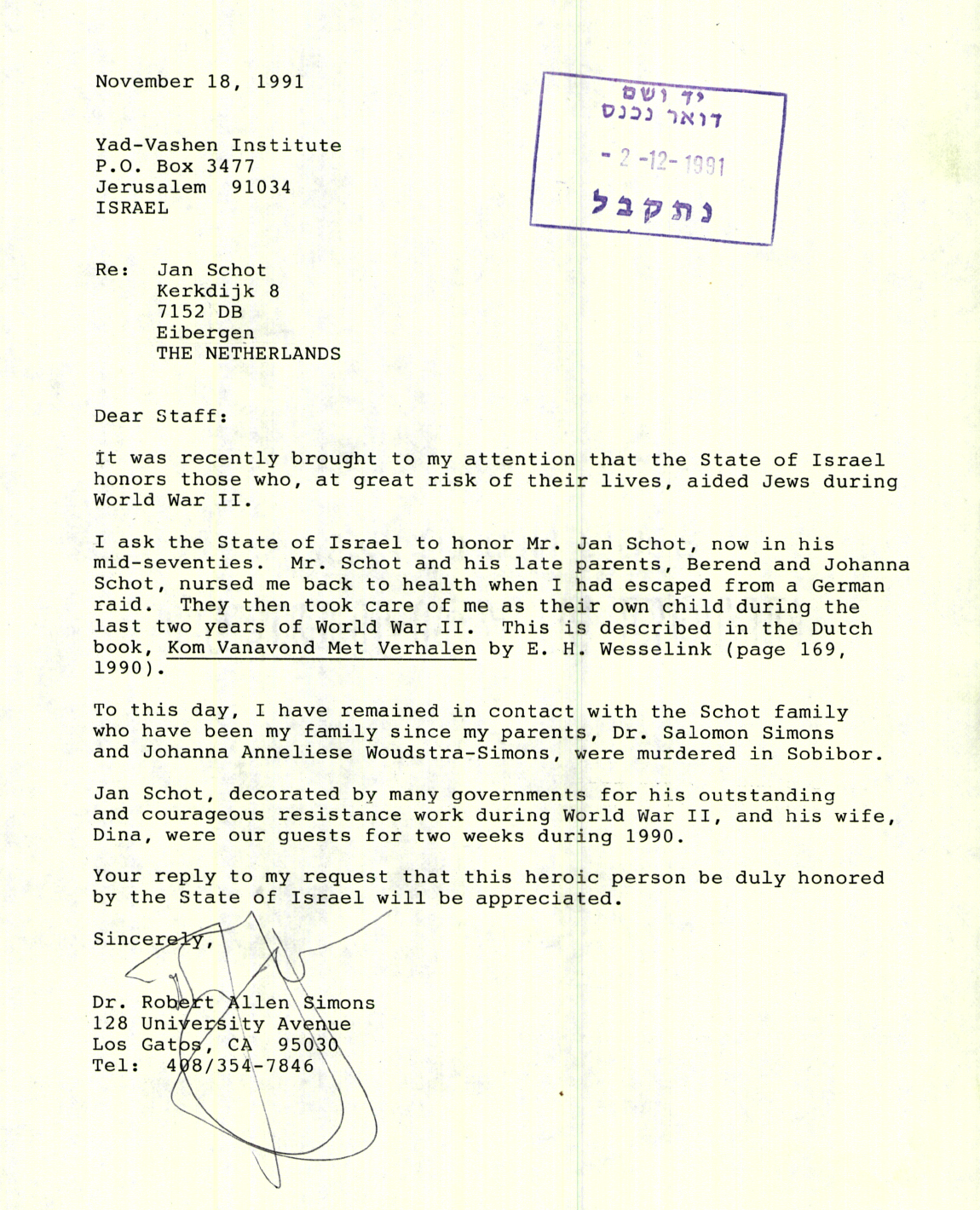
I am Dr. Robert Allen Simons, born in Enscnede, I was born on November 23,1931, the elder of two sons of Dr. Solomon Simons and his wife, Anneliese Johanna Simons, who were murdered in Sobibor, Poland on July 4, 1943 and July2, 1943 respectively.
I was a child during World War II. I was initially hidden in Haarlem, The Netherlands. The address is not known to me. I was captured but escaped and was then hidden in Lleiden, The Netherlands. Again, the address is not known to me. From there, I was smuggled to the Schot farm in Hupsel, near Eibergen, The Netherlands.
I was a child during World War II. I was initially hidden in Haarlem, The Netherlands. The address is not known to me. I was captured but escaped and was then hidden in Lleiden, The Netherlands. Again, the address is not known to me. From there, I was smuggled to the Schot farm in Hupsel, near Eibergen, The Netherlands.
The Righteous among the nations
ID item 4059850
Value-aligned goals -collective actions aimed at interpreting social values through the principle of equality.
Symmetric tie - A social connection between a bearer of a rejected identity and a citizen, formed with the aim of achieving value-aligned goals.
Consensus network - A network of agents contributing time, skills, and resources to improve the chances of achieving value-aligned goals
The Dutch underground provided my parents with a hiding place in Haarlem. I was hidden with another family and my brother was hidden by still another family. All Dutch nationals who hid me, fed me, clothed me and loved me did so because of their convictions. It was well-known at the time that hiding of Jews could result in the death of the rescuers.
The Righteous among the nations
ID item 4059850
Value-aligned goals -collective actions aimed at interpreting social values through the principle of equality.
Symmetric tie - A social connection between a bearer of a rejected identity and a citizen, formed with the aim of achieving value-aligned goals.
Consensus network - A network of agents contributing time, skills, and resources to improve the chances of achieving value-aligned goals
My presence was usually explained to the Germans as being a relative of the rescuers. The neighbours in Hupsel were solid in their silence. The [Schot]farm was raided, but no incriminating evidence was ever found.
Several times the Schot family moved me to the small farm of their married daughter, Mina andher husband, Gerrit-Jan Hulshof. The Hulshofs had no children and gave me all their love and attention.
Several times the Schot family moved me to the small farm of their married daughter, Mina andher husband, Gerrit-Jan Hulshof. The Hulshofs had no children and gave me all their love and attention.
The Righteous among the nations
ID item 4059850
Value-aligned goals -collective actions aimed at interpreting social values through the principle of equality.
Symmetric tie - A social connection between a bearer of a rejected identity and a citizen, formed with the aim of achieving value-aligned goals.
Consensus network - A network of agents contributing time, skills, and resources to improve the chances of achieving value-aligned goals
No names and addresses of others helped by the Schot family are known to me. The Schot family helped many Jews. Allied fliers escaped to England through the Schot farm and forced labourers who escaped from Germany were also helped. All these people were fed, comforted and placed with neighbouring farm families.